

7 Rule Changes the NHL Needs to Make
- Logan Horn
- Mar 7, 2022
- 10 min read


It’s not a radical idea to say that the NHL could improve itself. The league is constantly growing and changing, and the rules and regulations should also be improving to best serve the players and the fans as well.
Have you ever been watching hockey with someone who doesn’t know the rules too well and they ask you to describe something like how the Offside rule works? It’s usually easy enough to describe that the puck must enter the zone first before any player from that team, but then you get the dreaded follow-up questions, “why?”. Why do you get a penalty for shooting the puck over the glass, but only if you’re defending? Why can’t the goalie touch the puck in the corner? Why are teams rewarded for losing?
These “Why” questions are valid and so today I will be going over 7 possible rule changes that I believe the NHL should make. They are ordered from least to most important, as well as least to most likely to change.
7. Extend 3 on 3 overtime from 5 to 10 minutes

(Johnny Gaudreau of the Calgary Flames is one of the most exciting players to watch in 3-on-3 OT)
The NHL made a great decision a few years ago to only allow each team to ice 3 players at a time in the Overtime period. The extra room on the ice afforded by having 4 less people skating around gives each team’s best players a great chance to show off their skills.
There have been countless exciting 3-on-3 overtime goals as the time limit means that the best 3-6 players for each team will play the majority of the 5-minute period.
Shootouts were a novel idea in the early 2000s, but they have been gradually losing their support from hockey fans, as distilling an entire game down to a 1-on-1 skills competition isn’t nearly as satisfying as an OT winning goal. That is why I believe the 3-on-3 Overtime period should be extended to 10 minutes long, giving each team an even better chance of ending the game before a shootout.
6. Let teams wear more jerseys! (cool warm-up jerseys should be used in game)

(Warmup jersey worn by the LA Kings to celebrate Black History Month)
The NHL began to experiment with extra jerseys last season with their “Reverse Retro” series that each team participated in. The Reverse Retro theme is coming back again next season with each team currently developing yet another jersey. Regardless of how good or bad some of these jerseys were, it has been nice to see the NHL embracing “event-style” jerseys.
One of the coolest things in the NBA is the wide variety of jerseys that each team can choose from. Whether it’s retro styles, brand new ideas, or mixtures of the two, most NBA teams have
At least 4 jerseys to pick from each season.
The NHL caps it’s teams at 3 most years. You get your Home jersey, your Away jersey, and then one Alternate jersey that you can only wear at home.
To be fair, I don’t know that this is a rule from the NHL and not just the Owners/Presidents of NHL teams not knowing how to market their teams and make a ton of extra money off cool new jerseys.

(Warmup jersey worn by the Vancouver Canucks to celebrate the Lunar New Year)
For a while now, NHL teams have created a variety of interesting and exciting jerseys for in-arena events, but they only wear them for the warm-up before the game and change back to their regular jerseys before the game starts. Imagine if we could see the LA Kings wear their Black History month jerseys in game, or the Canucks wearing their Lunar New Year jerseys (one of the coolest hockey jerseys of all time in my opinion). Teams should have the freedom to experiment with their jerseys and try out a bunch of cool new ideas in game.
5. FREE THE GOALIE! (get rid of trapezoid rule)

(Martin Brodeur was famous for his excellent puck handling skills, leading to the introduction of this rule)
One of the weirder NHL rules is that goalies are not allowed to touch the puck while it is in the corners of the rink. They can stickhandle it in front of the goal line as well as behind the net, but as soon as the puck enters the corner, it is off limits to goalies.
I know it was Martin Brodeur’s fault that this rule was introduced, but he’s gone now. Can we stop pretending that this rule makes any sense? Please?
Everytime that a goalie gets a penalty for touching the puck when it is 1 inch over the line, my eyes roll so hard that they might get lost in the back of my head forever. Not every goalie will take advantage of the new freedom, but why should goalies who have better stickhandling skills be penalized for trying to play or retrieve the puck?
This rule is outdated and needs to be removed to free goalies up. If the idea is that leaving the puck there causes more offensive pressure, leading to more goals, then I only ask you to watch how bad goalies are at playing the puck and how many times they pass it directly to an opposing player. If your motive is to increase goals scored, then let goalies play the puck more. If your motive is to get rid of ridiculous rules, then this is a great one to start with.
4. More Severe Discipline
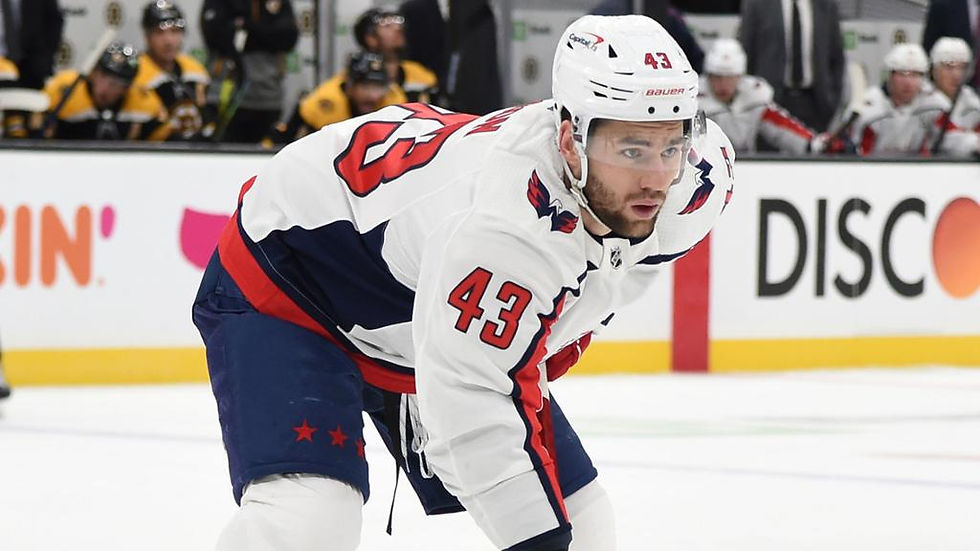
(The Washington Capitals' Tom Wilson has been suspended multiple times, but it never seems to change the dangerous way he plays)
The Department of Player Safety (NHL DPS) rules the NHL with whatever the opposite of an Iron Fist is. Players who do stupid and dangerous things (like purposefully tripping players heading toward the boards at high speeds, spearing players in the ribs, bodychecks to the head) should be punished, but the NHL DPS seems incapable of properly punishing their players.
I understand that when it comes to fines, the CBA (Collective Bargaining Agreement between the NHL and the Players Association) dictates how much any one player can be fined for an action, but the DPS has more control over suspensions, and should be using them to their advantage to make the NHL a safer place for their players.
Firstly, the fines are a joke. If a player makes $5M/year and does something stupid in a game, they will likely be fined $5,000, which is the maximum allowed in the current CBA. That is the equivalent cost of someone who makes $50k/year being fined 50 dollars. Not exactly the kind of punishment that will lead to substantive change. I don’t care if it takes a lockout, but I believe the NHL should firmly set higher standards when negotiating the next CBA so that they can fine players up to $50k for a reckless and dangerous action, with options for appeals like there already is for suspensions.
Second, suspensions do very little to prevent dangerous plays and hits in hockey game because players do not fear the repercussions of their actions. There have been plays where the suspended player was deemed to be acting with the intent to injure the other player, and they have only been given a 1-game suspension. How does that make sense? If I was in charge of the DPS and I believed a player was trying to injure someone else, then that player would be suspended for a minimum of 10 games, or for the duration of the victim’s injury if their recovery takes longer.
This is a professional hockey league, not MMA on ice. Protect your players.
3. New Points System

(Pittsburgh's Casey DeSmith exiting the ice to give his team the extra attacker)
Here is where my rule change suggestions will begin to get more controversial. I believe that the NHL should move to integrate the IIHF rules for team points. Under these new rules, teams would receive 3 points for a regulation victory, 2 points for an OT win, 1 for an OT loss or a Tie and 0 for a regulation loss.
The NHL is currently incentivizing boring, safe hockey in the final 10 minutes of a game, as teams have decided to take less risks and coast to the free point they earn as soon as regulation ends, and the teams are tied. If a regulation win was worth more than an OT win (as it should be), then imagine a game toward the end of a season where a team that is desperate for points pulls their goalie in the final minutes of a tied game. The excitement, the chaos, it’s all just one rule change away!
I know that the NHL prides itself on old records that are kinda irrelevant at this point because players couldn’t lift the puck off the ice until 40 years ago, so they would be hesitant to add more points to each game. The NHL record for points in a season would be obliterated in the first season these rules are introduced, but then the NHL could just focus on most wins in a season if they care about their record books so much.
I believe that regulation wins should be worth more than a win in OT, and this rule would make that value much more tangible. I also believe that the NHL should do away with shootouts and bring back the Tie as a possible game result. However, if they make wins even more valuable, and include my earlier rule that OT now goes for 10 minutes, I don’t think there will be many games ending in a Tie. Ties would be worth 1 point for each team, just like an OT loss.
2. Introduce “The Gold Draft”

(The 2021-22 Arizona Coyotes are the first team to clearly tank since 2015)
The NHL has a major issue with tanking. Whether you look at Edmonton and Buffalo fighting for the right to draft Connor McDavid in 2015 by trading away pretty much everyone with a pulse or the 2021-22 Arizona Coyotes who are currently deep within the “Fight for (Shane) Wright”, this issue is clear. Not only are teams being rewarded for losing, but this has conditioned far too many hockey fans to root for their team to lose.
My proposed solution is the introduction of “The Gold Draft” system as described by Adam Gold in 2012. I’ll share a link to a much more detailed description of this method (https://hockeyviz.com/txt/gold), but in essence, it aims to incentivize winning over anything else, while having a few rules in place to give head starts to the bad teams across the league.
This would get rid of any sort of draft lottery, no more luck enhanced by losing. The team that earns the right to draft 1st overall is the team that has earned the most “Gold Points”. What are gold points? Gold points are earned in the same way as regular team points (2 for a win, 1 for OT loss, 0 for loss), but are added up separately. When a team is mathematically eliminated from the playoff race, then they enter the Gold Race where their point total resets and all of the points they earn from then until the end of the season are Gold points.
Teams would also be given the option to opt-out of the playoff race at any point in the season in order to pursue the Gold Race, but they would also be opting out of the playoffs. This means that even after a team has no chance of making the playoffs, winning is still key.
You may be thinking to yourself “but if teams are bad, how are they going to win enough games to earn Gold points?”, and that is a fair question. However, the league is more even than it has ever been. The Coyotes are 32nd in the NHL and are terrible, but they have won 2 of their 3 games against the Colorado Avalanche, the best team in the league. The Coyotes would be even better if they were still trying to actively win games in order to have the best chance at 1st overall rather than deliberately aiming to lose. In over 6 million simulations of the NHL under this Gold System, it was found that the first teams eliminated from the playoffs were consistently in the very top of the draft order as well, so that needn’t be a worry.
With this method, every fan will be cheering for their team to win, and teams will never again trade away players who are playing well in order to lose more games. Imagine a late-season game between two teams fighting for position in the Draft Standings, it would have the same value behind it as a game between two teams fighting for playoff spots. I would love to never again hope my team loses, so I believe the NHL should make “The Gold Draft” a reality.
1. No More Bodychecks

(Paul Kariya's career was shortened by a variety of concussions he sustained in games)
As I mentioned at the start, my suggestions are ordered least to most controversial, and I think this one makes that clear. I believe that the NHL should make full bodychecks illegal in the interest of player health and safety.
Watching Women’s hockey at the Olympics this winter, I was struck with how the IIHF penalized the players for bodychecking. Bumps and shoves are still allowed, but a strong bodycheck will land you in the penalty box.
If we want to watch the best hockey players play hockey, then why do we settle for rules that end up in far too many injuries? I understand that a good chunk of the NHL fanbase loves a big hit, and I can’t say I haven’t cheered after a handful of hits myself, but we need to ask ourselves why? Why did I cheer while watching Jonathan Toews being concussed by Willie Mitchell as he exited the penalty box? Why is Torey Krug celebrated for skating the length of the ice to hit someone as hard as he can?
The hockey world has fetishized violence and it is time to fix that. Too many players are sustaining unnecessary injuries that greatly affect their quality of life now, as well as when their careers are over. Look at superstars like Paul Kariya who had his career shortened by concussions sustained in hockey games, or the 20-year-old defenceman Bowen Byram who has played half of the games he’s been eligible for over the last two seasons because of multiple concussions. Or how about the numerous “enforcers” who have been killed by suicide because of CTE as well as drug abuse initiated by the dangerous painkillers that they have been issued by team doctors.
I know that the NHL doesn’t care as much about their players as they care about their money, so I’ll appeal to their selfish side. Imagine if Sidney Crosby hadn’t missed so many games due to concussions early in his career. He could have an extra 200 points or so and would be in the conversation for the greatest player of all-time, wouldn’t the NHL love to have that kind of player to market?
Even players who don’t suffer multiple serious concussions in their career often see their quality of life decreased during and after their playing careers because of completely avoidable injuries. Ryan Kesler has shared how he is almost unable to walk some days because of the serious hip injuries that he sustained and played through as a part of hockey’s violent “tough-guy” culture.
If you watched any Women’s hockey at the Olympics, then you know how much fun it was to watch, and the lack of hits did not make a difference. If you love hockey like I do, the let’s watch hockey and not some poor guy whose only value to his team is that he can hurt players on the other team.

(The NHL's Commissioner, Gary Bettman, would likely hate my list)
In the end, I don’t expect any of these rules to change anytime soon, but I can dream.
What do you think of my proposed rules? How many of them do you think the NHL should introduce? Let me know in the comment section down below.


Comments